What is the “Self” in Internal Family Systems therapy? The key to lasting healing.
If you've been exploring therapy options for emotional healing, you may have come across Internal Family Systems (IFS) therapy. This transformative approach has helped countless people heal from trauma, anxiety, depression, and relationship challenges. At the heart of IFS lies a profound concept: the Self.
But what exactly is the Self in IFS therapy, and why is it considered the key to healing? Let's explore this foundational concept and how it can transform your therapeutic journey.
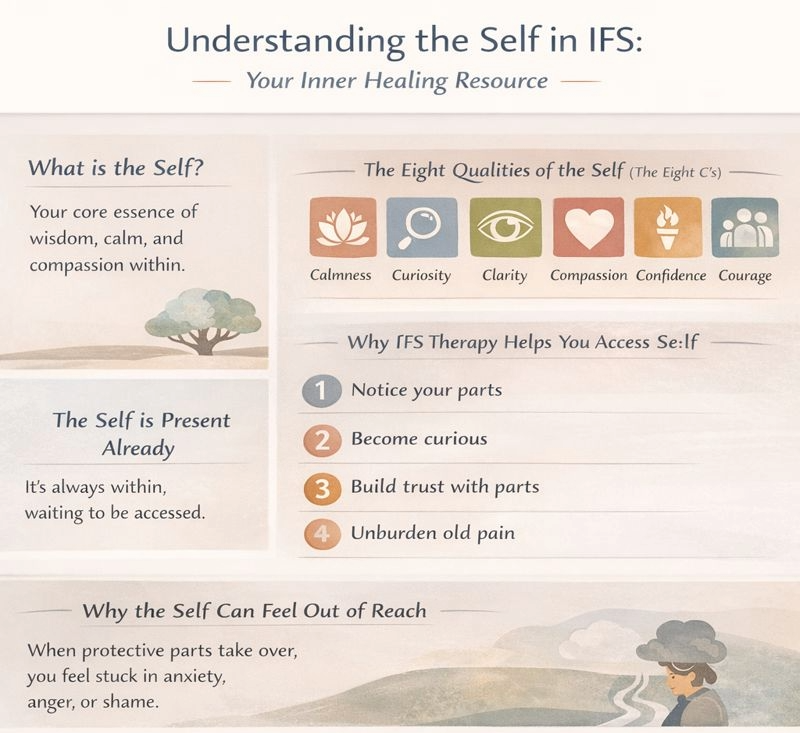
Understanding the Self in IFS: Your Inner Healing Resource
In Internal Family Systems therapy, the Self is not another part. The Self is your core essence, an innate source of wisdom, compassion, and clarity that exists within everyone. Developed by Dr. Richard Schwartz, IFS proposes that beneath all our wounded parts, defensive behaviours, and emotional struggles lies this unchangeable, undamaged centre.
Think of the Self as your inner calm in the storm. No matter what you've experienced or how fragmented you might feel, your Self remains whole, wise, and capable of healing. It's not something you need to create or develop through therapy. Rather, it's already there, waiting to be accessed.
The Eight C's: Qualities of the Self
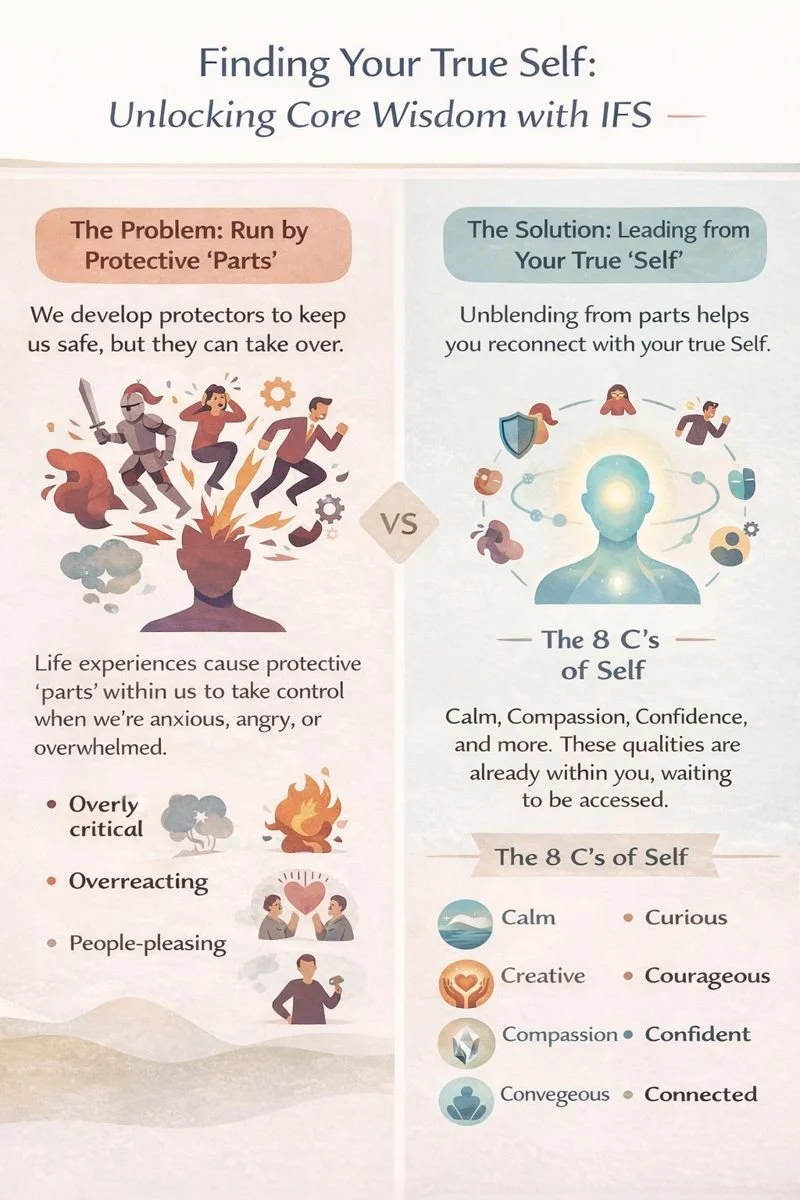
How do you know when you're in Self? IFS identifies eight core qualities that emerge naturally when we're connected to our Self energy. These are known as the Eight C's:
Calmness - A sense of peace and steadiness, even in challenging situations
Curiosity - Genuine interest in understanding our parts and experiences without judgment
Clarity - The ability to see situations accurately, free from the distortions of our protective parts
Compassion - Deep kindness toward ourselves and others
Confidence - Trust in our ability to handle what arises
Courage - Willingness to face difficult emotions and experiences
Creativity - Access to fresh perspectives and innovative solutions
Connectedness - Feeling part of something larger than ourselves
When you're experiencing these qualities, you're operating from Self. This state allows you to approach your internal world with the perfect therapeutic stance, which is why the Self is considered the ideal healer.
A short guide to understanding Self in IFS.
Why the Self is the Key to IFS Therapy
Traditional therapy often positions the therapist as the primary agent of change. IFS takes a radically different approach. While the IFS therapist serves as a guide and facilitator, the real healing happens when your Self takes the lead in relating to your parts.
Here's why this matters:
The Self Knows What You Need
Your Self has an innate wisdom about your internal system. It knows which parts need attention, what they're protecting you from, and what they need to feel safe enough to change. No external expert, however skilled, can know your inner world as intimately as your Self does.
The Self Can't Be Overwhelmed
Unlike our parts, which can become flooded with emotion or reactivity, the Self remains steady. It can hold space for intense feelings without being consumed by them. This capacity is essential for healing trauma and working with deeply wounded parts.
The Self Offers Unconditional Positive Regard
Our protective parts often judge, criticize, or try to exile our wounded parts. The Self, however, approaches all parts with curiosity and compassion. This accepting presence is precisely what allows burdened parts to finally release their pain and transform.
Healing Becomes Sustainable
When healing comes from your own Self rather than depending solely on a therapist's presence, it becomes portable and lasting. You develop the ability to access your Self in daily life, allowing you to navigate challenges with greater ease long after therapy ends.
What Blocks Access to the Self?
If the Self is always present, why don't we experience it all the time? The answer lies in our parts.
Throughout life, we develop various parts to help us cope with challenges, pain, and overwhelming experiences. Some parts protect us by keeping emotions at bay (managers). Others react impulsively when we're triggered (firefighters). Still others carry the burdens of painful memories and emotions (exiles).
When these parts are activated and trying to protect us, they can blend with us so completely that we lose access to Self energy. You might experience this as being "taken over" by anxiety, anger, or shame. In these moments, you're not operating from Self but from a protective part that's trying to help in the only way it knows how.
How IFS Therapy Helps You Access Your Self
IFS therapy is designed to help you unblend from your parts and access your Self. This process typically involves:
Noticing your parts - Learning to recognize when you're blended with a part rather than in Self
Getting curious - Asking parts about their roles, fears, and needs from a place of genuine interest
Building trust - Helping protective parts feel safe enough to step back and let Self lead
Witnessing and unburdening - Allowing the Self to be present with exiled parts, witnessing their pain and helping them release old burdens
Through this process, you develop what IFS calls Self-leadership. Your parts begin to trust that the Self can handle things, and they no longer need to work so hard to protect you. This internal shift creates space for profound healing and transformation.
To help with this process I have written a free Guide to Mapping Your Parts.
Experiencing Self-Led Living
As you work with IFS therapy, you'll likely notice changes in how you experience daily life. You might find yourself:
Responding to triggers with curiosity rather than reactivity
Feeling more compassionate toward yourself and others
Making decisions from a place of clarity rather than fear
Accessing calm even in stressful situations
Feeling more connected to your authentic desires and values
This is what Self-led living looks like. It's not about being perfect or never struggling. Rather, it's about having a reliable inner resource that can help you navigate whatever arises.
Beginning Your IFS Journey
Understanding the Self intellectually is valuable, but experiencing it firsthand is transformative. If you're considering IFS therapy, know that your Self is already present, waiting to lead your healing journey. An experienced IFS therapist can help you access this innate wisdom and begin the process of unburdening your parts.
At A New Chapter, I offer online IFS therapy for clients across Australia and beyond to help you connect with your Self and create lasting change from the inside out. Whether you're dealing with trauma, anxiety, relationship challenges, or simply feel disconnected from yourself, IFS provides a compassionate path toward healing.
Your Self has been with you all along. It's time to let it lead the way to your new chapter. To get started with IFS therapy, book a no-pressure 20 minute connection call.
