Can You Do IFS Therapy by Yourself? A Guide to Self-Led Parts Work
You've been reading about Internal Family Systems therapy. You understand the basics: that your mind is naturally divided into parts, each with its own perspective and protective role. You're intrigued by the idea of befriending these parts instead of fighting them. But you're wondering: Can I do IFS alone?
It's one of the most common questions I hear as an IFS therapist, and the answer isn't a simple yes or no. The truth is more nuanced (and more empowering) than you might think.
The short answer: Yes, self-led IFS practice is possible and powerfully beneficial. And there are important caveats.
Self-led IFS practice is absolutely possible. Thousands of people work with their parts independently, building awareness and compassion for their internal systems. But like any powerful therapeutic approach, there are important boundaries to understand before you begin solo work.
What This Guide Covers
In this article, you'll discover:
What self-led IFS practice actually looks like and which techniques are safe to explore independently
The genuine benefits of working with your parts on your own
When a IFS therapist enhances your work and takes it to deeper levels
When professional support is essential for safe healing
Practical tools you can start using today to build relationships with your parts
How to create a balanced approach that honours both self-practice and professional guidance
Whether you're exploring IFS for the first time, already in therapy and wanting to deepen your between-session practice, or trying to decide if you need professional support, this guide will help you make informed decisions about your healing path.
Can You Practice IFS Without a Therapist?
Yes, many aspects of IFS can be practiced independently, especially once you understand the foundational concepts. Self-led IFS practice (also called "Self-to-Self" work) involves using IFS principles and techniques to connect with your parts on your own.
Independent IFS practice has genuine, unique benefits that therapy alone cannot provide.
1. You Build Direct Relationship with Your Parts
When you work with your parts on your own, they're relating directly to YOUR Self, not to your therapist's Self. This builds an internal capacity that stays with you forever.
In therapy, parts might initially trust your therapist more than they trust you (and that's valuable for getting started). But ultimately, you're the one who lives with these parts 24/7. Building your own Self-leadership means you don't need external validation or guidance for every internal moment.
2. You Develop Internal Authority and Trust
Self-practice builds confidence in your own inner knowing. You learn to trust that you can:
Recognise when parts are activated
Distinguish between Self and parts
Navigate your inner world with competence
This internal authority is empowering as you're developing your own expertise about your internal system.
3. You Work at Your Own Pace
In therapy, there's a clock. In self-practice, you can:
Spend as much time as a part needs
Revisit conversations over days or weeks
Go slowly when something feels tender
Speed up when you're ready
Follow your system's organic timing
Your parts know their own readiness. Self-practice honors that and can look like journaling with a part over multiple days, and sitting with a realisation for a week before going deeper.
4. You Build Sustainable, Lifelong Practice
Therapy eventually ends. Self-practice becomes a lifelong relationship with yourself.

What IFS Work You CAN Do By Yourself (And Why It's Valuable)
Here are some IFS practices that work beautifully solo.
Parts Mapping
What it is: Creating visual diagrams of your internal system (which parts exist, what they protect, how they relate).
Why it's valuable:
Externalises your system so you can see it objectively
Identifies patterns you can't see when you're in it
Helps you understand the logic of your protective strategies
Creates a reference you can update as you learn more
Especially helpful for visual thinkers
How to do it:
Draw Self in the centre
Add circles around it representing different parts
Label each part and its primary role/emotion
Draw arrows showing relationships (which parts protect which exiles)
Update as you discover more
Read more about parts mapping here and access my free parts mapping guide here.
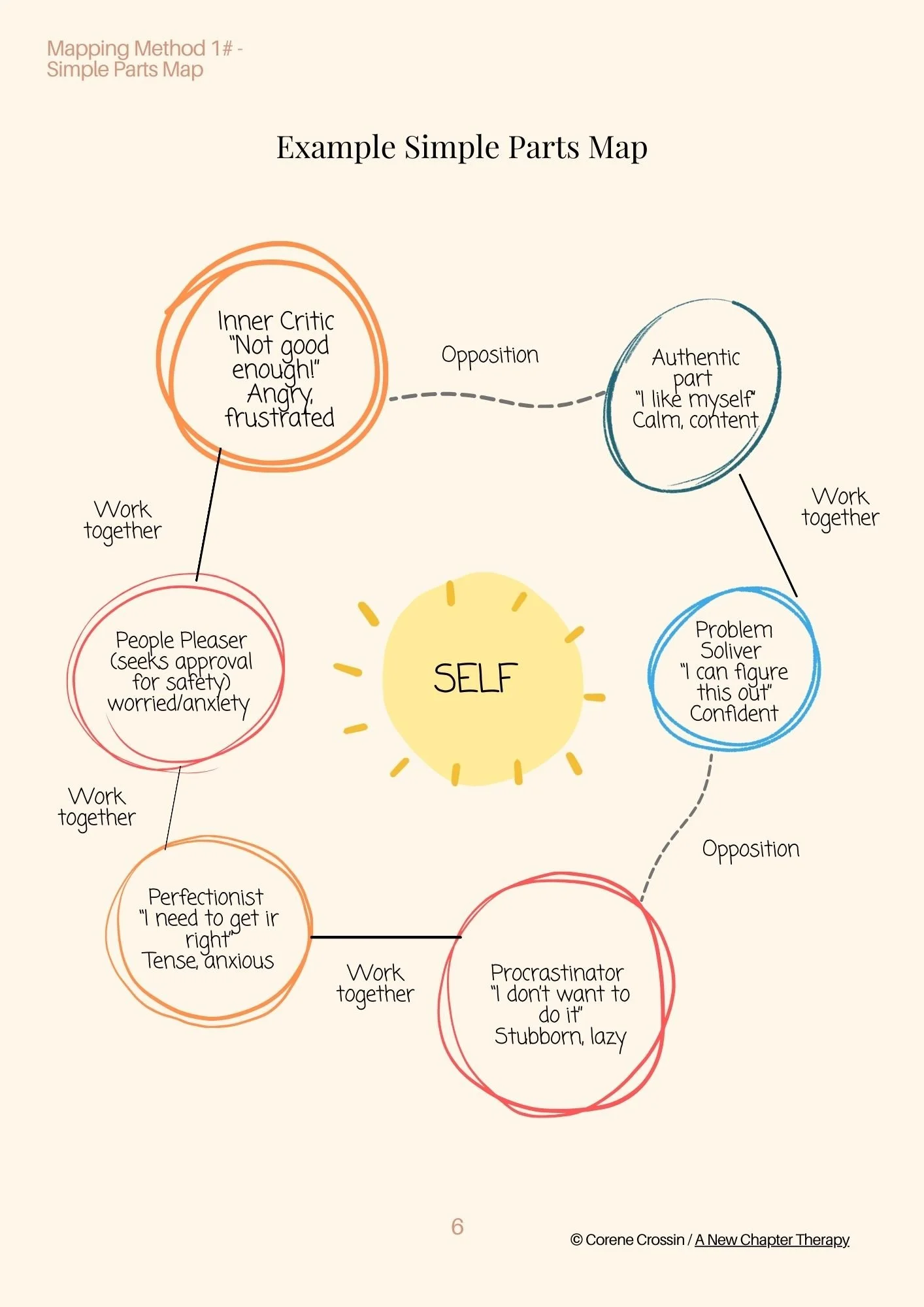
An example parts map from my free guide to IFS parts mapping.
Daily Parts Check-Ins
What it is: 5-10 minutes of tuning into your internal system and asking: "Who's here today? What do you need me to know?"
Why it's valuable:
Builds daily awareness before problems escalate
Catches parts early when they're easier to work with
How to do it:
Sit quietly and take a few breaths
Ask: "Who wants my attention today?"
Notice what arises (a feeling, thought, or body sensation).
Ask that part: "What do you want me to know?"
Listen and acknowledge
Parts Journaling
What it is: Writing dialogues between your Self and your parts, or letting parts express themselves freely on paper.
Why it's valuable:
Creates natural separation between Self and parts (writing inherently unblends you)
Provides a record you can track over time
Lets parts express things they can't say "out loud"
How to do it:
Draw a line down one page. On the left write thoughts held by the part that is most active. On the right hand side, write a response to those thoughts from Self.
For example:
Part: "I'm exhausted from trying to be perfect"
Self: "I hear how tired you are"
Or, try a free-writing format: "I'm going to let my anxious part write for 10 minutes..." [Let it pour out without editing]

When a Therapist Enhances IFS Work
A skilled IFS therapist doesn't just "do IFS to you; they enhance and accelerate work you can't fully do alone. Here's when professional support takes your practice to another level.
A Therapist Provides Co-Regulation
Your therapist's calm, regulated nervous system helps regulate yours. This isn't just emotional; it's physiological. Their presence creates safety that allows parts to emerge that won't come forward when you're alone.
Why you can't fully replicate this solo: We are relational beings. Some healing simply requires another nervous system as a resource. Parts that carry overwhelming pain need to feel held by another person, not just by your own Self.
A Therapist Sees Your Blind Spots
We all have parts we can't see, either because they're so blended we don't recognize them, or because other parts hide them from view. A therapist spots these patterns.
Why you can't fully replicate this solo: You can't see what you can't see. It's the nature of blind spots. A therapist notices when a part is blocking access, when you're unknowingly blended, when your system has patterns you're too close to recognise.
A Therapist Helps Navigate Protector Resistance
Sometimes protectors simply won't trust you (at least not yet). But they might trust your therapist. A therapist can:
Negotiate with protectors on your behalf
Help protectors feel safe enough to step back
Address protectors' concerns about the work
Get permission for accessing exiles
Protectors developed precisely because parts of you felt unsafe. They're not going to relax just because you (the very person they're protecting) ask them to. An external presence can broker trust.
A Therapist Guides Safe Pacing
A therapist knows when to go deeper and when to consolidate. They can sense when your system is ready for more and when it needs time to integrate. They prevent you from:
Moving too fast and re-traumatising yourself
Moving too slow and staying stuck
Missing signs that you're overwhelmed
Pushing past your window of tolerance
Parts can pull you in both directions: some wanting to rush healing, others wanting to avoid it entirely. When you're in your own system, it's hard to maintain the objective perspective needed for good pacing.
A Therapist Facilitates Unburdening
Unburdening is the IFS process where parts release the painful beliefs and emotions they've carried. This is the most transformative aspect of IFS. While you can do preparatory work solo, the actual unburdening process works best with a witness.
Parts often need to be SEEN in their pain by another person for deep healing. Your therapist's witnessing allows parts to:
Feel truly validated (not just by you, but by another)
Release burdens they've held for decades
Experience that it's safe to be vulnerable
Know they're not alone in the pain

When Professional Therapeutic Support Is Essential
Now for the hard boundaries. There are situations where self-practice isn't just less effective but also potentially harmful. Here's when you absolutely need support from a professional, trained IFS therapist.
Complex Trauma or C-PTSD
Why therapy is essential as complex trauma creates a fragmented internal system with:
Multiple traumatised exile parts
Extreme protective responses
Narrow window of tolerance
Difficulty accessing Self
You need a therapist to provide co-regulation for overwhelming emotions and help you stay in your window of tolerance. IFS work needs to be taken slowly (especially when complex trauma is present) and attuned professional care is required to help stabilise you between sessions.
Extreme Protector Behaviours
Therapy is essential as some protective strategies create serious consequences including:
Active addiction
Eating disorders
Harm or violence toward self or others
Dangerous sexual behaviours
Severe self-sabotage
When these patterns are present you need a therapist to help address immediate harm, create safety plans (and this may include working with other mental health support services) and support greater stability within your system before doing deeper work.
You're Completely Stuck
Therapy can also be helpful if you've been practicing IFS self-work for months and you feel more confused, symptoms are worsening, you can't access Self, and parts won't communicate.
A therapist can be helpful to identify what's blocking progress and spot patterns you can't see. A trained IFS therapist can also offer new approaches and provide the external Self your system needs.
The Optimal Approach: Combining Professional and Self-Led IFS
The most effective path combines both: working with a trained IFS therapist for deep transformational healing while maintaining a daily self-practice for ongoing awareness and relationship-building with your parts.
Think of it like learning an instrument: you can practice scales at home, but periodic lessons with a skilled teacher help you progress faster.
Ready to Start Your IFS Journey?
I recommend considering starting therapy if:
You have trauma history
Parts won't respond to your self-practice
You're consistently overwhelmed
You have extreme protector behaviours
You want to go deeper than self-practice allows
You want to accelerate your healing
About the Author
Corene Crossin is an Australian registered psychotherapist and IFS practitioner based in Brisbane, offering online Internal Family Systems therapy to clients across Australia and internationally. She works with thoughtful adults who are ready to explore longstanding patterns around relationships, attachment, self-sabotage, body image, and inner criticism.
Her approach is trauma-informed, collaborative, and rooted in compassion. She believes that lasting change becomes possible when you feel safe enough to be fully seen, including by yourself.
Ready to begin your own inner work?
Download the free IFS Parts Mapping Guide to start exploring your parts, or book a free 20-minute connection call to discuss how IFS therapy might support you.
Explore other articles:
How to deal with your Inner Critic with IFS
