Understanding (and Healing) Avoidant Attachment with IFS
Have you ever felt you need to pull away just when a relationship starts getting too close? Maybe you find yourself getting annoyed when someone wants to talk about feelings, or you feel suffocated when a partner needs reassurance.
If you've ever told yourself you're "just independent" while secretly wondering why intimacy feels so uncomfortable, you're not alone. These experiences point to what psychologists call avoidant attachment.
TL;DR
While traditional therapy often frames avoidance as a problem to fix, a therapy approach called Internal Family Systems (IFS) offers a different view.
Looking at avoidant attachment through a IFS view helps to see aren't a "cold" or "emotionally unavailable" as a whole person. Instead, you have parts that learned to protect you from the vulnerability and pain that comes with depending on others.
In this post, I'll explore where these patterns come from, and look at how parts work (using Internal Family Systems therapy) can help you find the connection you've been keeping at arm's length.

What is Attachment?
In simple terms attachment is the "relational map" we carry inside us. First developed by psychiatrist John Bowlby, attachment theory provides an explanation for how we relate to others (especially in times of stress or danger).
This "Internal Working Model" is built from our earliest interactions with caregivers. If our needs were met consistently, we developed secure attachment. But for about 40–50% of the population, that map is a bit more complicated.
Do I have avoidant attachment?
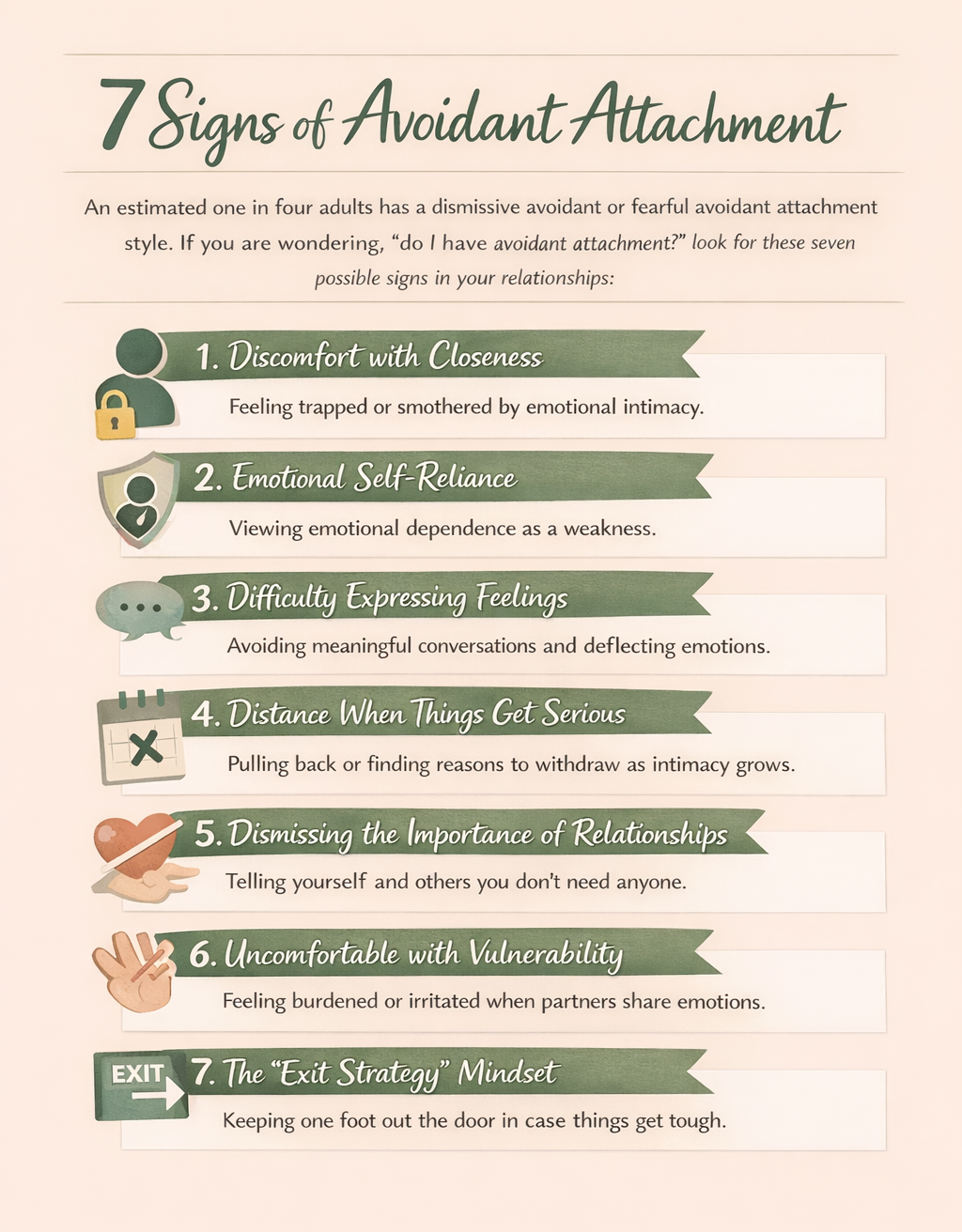
An estimated one in four adults has a dismissive avoidant or fearful avoidant attachment style. If you are wondering, "do I have avoidant attachment?" look for these seven possible signs in your relationships:
Discomfort with Closeness: You value your independence above all else and feel trapped or smothered when someone wants more emotional intimacy.
Emotional Self-Reliance: You handle problems alone and see needing others as weakness. Asking for help feels foreign or even shameful.
Difficulty Expressing Feelings: You might intellectualize emotions, change the subject when things get deep, or simply not know what you feel.
Distance When Things Get Serious: As relationships deepen, you find reasons to pull back. You might focus on your partner's flaws or suddenly get very busy.
Dismissing the Importance of Relationships: You tell yourself (and others) that you don't really need close relationships, that you're fine on your own.
Uncomfortable with Vulnerability: When someone shares their feelings or needs reassurance, you feel irritated, burdened, or like you're supposed to fix something.
The "Exit Strategy" Mindset: Part of you is always scanning for the door, keeping one foot out of the relationship just in case.
How Difficult Childhood Experiences & Trauma Causes Avoidant Attachment
Childhood trauma causes avoidant attachment, though it might not look like what you'd expect. Often, it's not about dramatic neglect but about emotional unavailability.
Imagine a child whose parent is physically present but emotionally distant. Maybe they dismissed emotions as "too much" or praised you for being "easy" and "independent."
Perhaps they were uncomfortable with feelings themselves, so you learned that expressing needs pushed them away. The child figures out: "If I don't ask for anything, if I handle it myself, if I don't show that I need them, I won't be rejected or burdened them."
In IFS terms, these early experiences create Exiles (the young, vulnerable parts that carry the heavy "burdens" of loneliness, the shame of needing others, and the terror of depending on someone who won't be there). To protect these Exiles, our system develops Protectors (Managers and Firefighters) who use avoidant strategies to keep you "safe" from the pain of unmet needs.
A New Perspective: IFS for Avoidant Attachment
Traditional attachment theory suggests that if you didn't learn to trust others as a child, you need corrective experiences in relationships to heal.
Internal Family Systems (IFS) takes this logic, and offers something different. It says you have a Self (an undamaged, wise, and compassionate core) that can provide the security your parts have been seeking.
Using Internal Family Systems for avoidant attachment involves a shift from avoiding connection altogether to building trust within yourself first.
1. Identifying the "Avoidant Cluster"
In IFS, avoidant attachment isn't just one thing. It's often a cluster of parts working together in a pattern. For example, you might have:
A Self-Sufficient Manager: A part that prides itself on not needing anyone and makes sure you can handle everything alone.
An Emotion Dismisser: A part that minimises feelings (yours and others') to avoid the messiness of vulnerability.
A Distancer: A part that creates space (physically or emotionally) when things get too close.
A Critic of Neediness: A part that judges you or others for having emotional needs.
Anbandoned Child (Exile): A part that actually carries the original pain of reaching out and finding no one there.
2. The Power of Unblending
When we are "avoidant," we are often blended with a protective part. This means the part has "taken over the pilot's seat," and we see vulnerability as dangerous through its eyes.
Unblending allows us to say: "I am not this distance. I have a part of me that creates distance right now." This creates the space needed for your Self (the 8 Cs: Calm, Curiosity, Compassion, etc.) to step in and understand why that part works so hard to keep you separate.
3. Witnessing and Unburdening
Instead of just trying to "be more open," IFS allows you to witness the story of your parts. You might go back to a memory where a part first learned that needing someone meant being let down or becoming a burden. You can offer it the presence it never received. Once the part feels heard, it can unburden (releasing the belief that depending on others is dangerous) and take on new, healthy roles.
If you are new to IFS and curious about getting to know your own parts check out my free Guide to Mapping Your Parts.
Moving Toward "Earned Security"
The goal of this work is "earned security". You may not have started with a secure map, but you can build one now.
By using Internal Family Systems therapy for avoidant attachment, you begin to see that the connection you've been avoiding is actually something you can learn to trust again, one small step at a time.
As your parts start to trust your core Self to handle vulnerability without being overwhelmed or abandoned, your external relationships will naturally shift. You will find you no longer need to keep people at a distance, because you are no longer afraid of what happens when they get close.
Need support with avoidant attachment?
Whether you're dealing with avoidant attachment, difficulty with intimacy, or relationship challenges, IFS provides a compassionate path toward healing. To get started, book a no-pressure 20 minute connection call.
About the Author
Corene Crossin is an Australian registered psychotherapist and IFS practitioner based in Brisbane, offering online Internal Family Systems therapy to clients across Australia and internationally. She works with thoughtful adults who are ready to explore longstanding patterns around relationships, attachment, self-sabotage, body image, and inner criticism.
Her approach is trauma-informed, collaborative, and rooted in compassion. She believes that lasting change becomes possible when you feel safe enough to be fully seen, including by yourself.
Ready to begin your own inner work?
Download the free IFS Parts Mapping Guide to start exploring your parts, or book a free 20-minute connection call to discuss how IFS therapy might support you.
