Breaking Free from the Drama Triangle: An IFS Perspective
TL;DR
The Karpman Drama Triangle describes three roles people can get stuck in relationships: Victim (helpless and blaming), Rescuer (fixing others while ignoring their own needs), and Persecutor (critical and controlling).
Being caught in this drama triangle feels both difficult and familiar because you likely learnt this pattern during childhood.
Internal Family Systems therapy offers a framework to help you understand why this dynamic is happening in your relationship, and how to break free.
Stepping out of the drama triangle starts with recognising your patterns and the parts of you that play different roles, and choosing new responses from a clearer, wiser standpoint.
This article explains why we get caught in drama triangles, and how parts work can help to create a healthier, more balanced way of relating to others. Book a free connection call here to explore how IFS can help you break free of toxic relationship patterns.
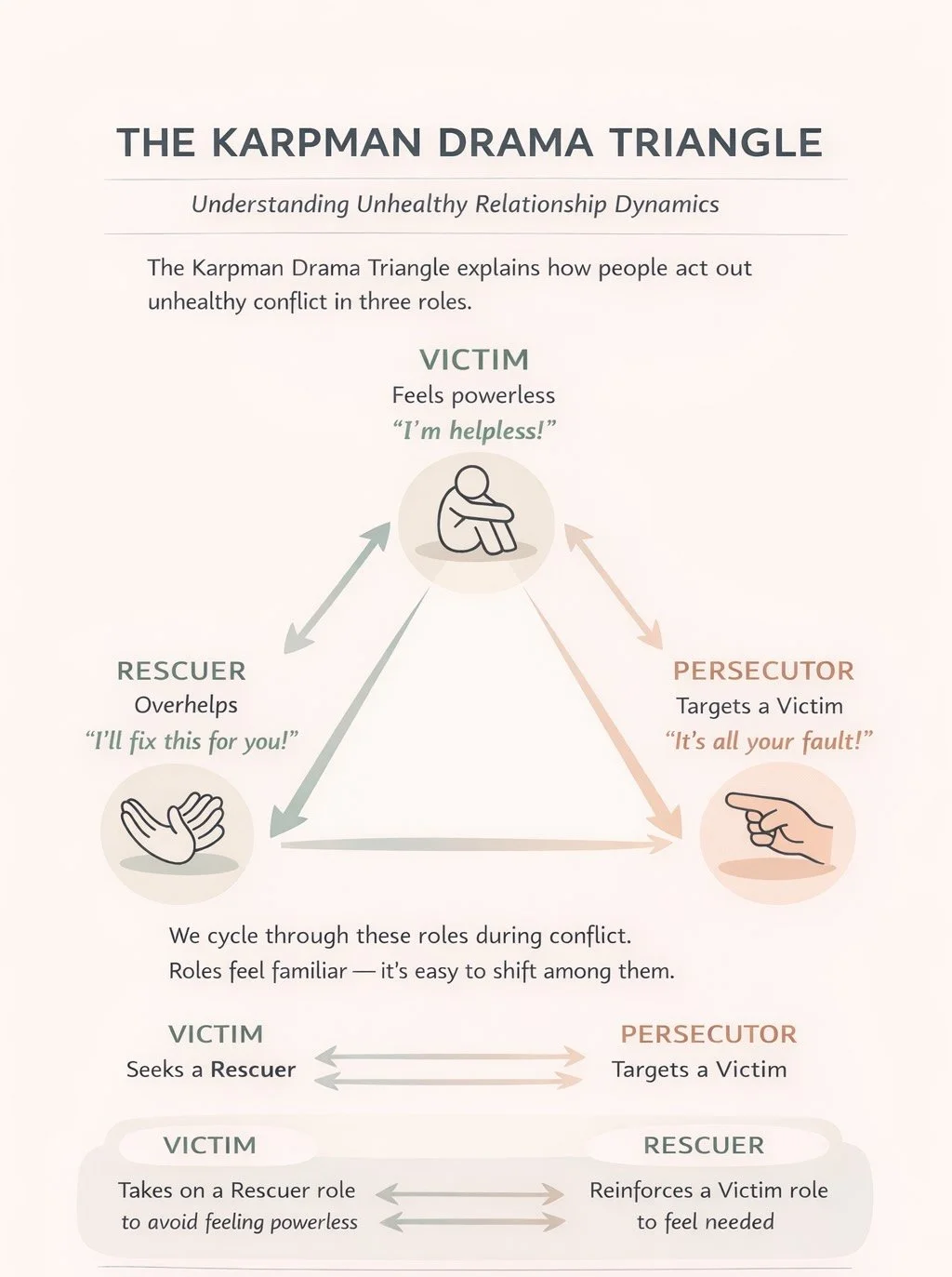
If you find yourself in patterns of conflict with your partner where you feel attacked, they feel blamed, and nothing seems permanently resolved, then you may be stuck in the Drama Triangle.
Psychiatrist Stephen Karpman described this pattern in 1968 by explaining how people get trapped in three toxic roles in relationships: Victim, Rescuer, and Persecutor.
Although we are capable of shifting between these roles, often we assume only one. Also, our early years may influence the role we fall into. For instance, if you grew up walking on eggshells and attempting to navigate emotionally volatile parents, you may have learned to be a Rescuer in an attempt to keep them calm.
Let’s look at each role briefly before a very important caveat about abusive relationships.
The Victim Role
The Victim feels powerless and oppressed. Things happen to victims, and they feel like they can't change anything. When we are in “Victim” mode other people feel like the cause of our distress.
In relationships if we adopt the Victim role, then we may blame our partner to place them in the Persecutor role, ultimately hoping that they will relent and take on the role of Rescuer.
Victims do feel genuinely feel stuck. But adopting this position lets us avoid taking responsibility. If we're powerless, we can't be blamed for how things turn out. The payoff for being in the Victim role is sympathy, attention, and getting to be right about how unfair everything is.
The Rescuer Role
The Rescuer swoops in to fix, save, and help the Victim. They take responsibility for other people's problems. They give advice nobody asked for. When we are in the Rescuer role we will do things for others that those people could actually do for themselves. Sometimes the Rescuer role is activated after we feel blamed or guilty about the Victim’s distress.
Rescuing feels good as the Rescuer looks helpful and important. But in rescuing, we might actually keep the Victim helpless. If we stopped rescuing, then the Victim would have to face their own problems.
The Persecutor Role
The Persecutor criticises, blames, and attacks. When we are in the Persecutor role we can see what's wrong with everyone else. Sometimes we become the Persecutor when we feel threatened, perhaps because we learned that attack is the best defence.
The payoff of playing this role is feeling powerful, in control, and protected from our own vulnerability. But when we are in this role, we can also cause pain and hurt in the person we care about the most.
A Very Important Caveat About Abuse
The Drama Triangle describes patterns between two people who have relatively equal power and are both contributing to a dysfunctional cycle. Abuse is not a cycle where both people share responsibility. Abuse is about one person using power and control over another.
Someone who is being abused is not "playing Victim." They are experiencing real harm. Someone setting boundaries or defending themselves against abuse is not "playing Persecutor." They are protecting themselves. Someone trying to prevent escalation or keep the peace is not "playing Rescuer" in a mutual dynamic. They are trying to survive.
If you're experiencing any of these in your relationship, this is not a Drama Triangle situation: physical violence, threats of violence, controlling your access to money or resources, isolating you from friends and family, constant criticism, monitoring your movements or communications, sexual coercion, destruction of your belongings, harm to pets as intimidation.
If you think you might be in an abusive relationship, please reach out to a domestic violence service. In Australia, you can call 1800RESPECT (1800 737 732). The focus should be on your safety, not on improving communication patterns.

An IFS Perspective on the Drama Triangle
Internal Family Systems offers a different lens for understanding the roles within the Drama Triangle. From an IFS perspective, each role includes parts of you that learned this was how to stay safe in relationships.
These parts developed for good reasons. Each role is protective, and each role is trying to meet real needs that weren't being met in other ways. The problem is they're still using strategies that worked when you were a child but don't work now.
Understanding the Victim Role as a Part
The Victim part can protect you powerful ways. For example:
Maybe you learned early that expressing helplessness was the only way to get care or attention. A part of you might have learned that showing competence meant being left alone, so helplessness became a strategy for connection.
Or maybe you have a Victim part protects you from the risk of trying and failing. If you're helpless, nobody can blame you for not succeeding. This part keeps you safe from disappointment and judgment.
Sometimes a Victim part protects you from responsibility. This part might carry fear about what it would mean to have agency. What if you make the wrong choice? What if people expect too much? Helplessness feels safer.
The Rescuer as a Part
The Rescuer part learned that your value came from what you could do for others.
Maybe you had a parent who was overwhelmed or struggling, and you learned early that taking care of them earned you love and approval. Or maybe your own needs were dismissed, but when you focused on helping others, you finally felt important.
A Rescuer part might also protect you from your own needs and vulnerability. If you're busy fixing everyone else's problems, you don't have to face your own. This part keeps you distracted from pain or emptiness that feels too big to handle.
Sometimes a Rescuer part protects you from the discomfort of watching others struggle. This part can't tolerate seeing someone in pain without jumping in. Maybe you learned that other people's distress was dangerous or that you were responsible for their feelings
Persecutor as an IFS Part
The Persecutor part learned that attack is the best defense.
Maybe you grew up in an environment where showing vulnerability meant getting hurt. This part internalised that being critical of others keeps you safe from being criticised first. If you point out everyone else's flaws, maybe they won't see yours.
Or maybe this part protects you from feelings of powerlessness or shame. When you feel small or scared, this part makes you feel big and in control. Criticism gives you a sense of power when you actually feel vulnerable underneath.
A Persecutor part might also protect you from disappointment. If you're critical of others, you can explain away why relationships don't work or why you feel let down. This part blames outward so you don't have to feel the pain of unmet needs or face your own longing for connection.
All Parts Carry Wounds
Each of these protective parts developed because something painful happened that needed protection. Understanding the protection and the wound underneath helps you approach your parts with compassion instead of judgment. They're doing their best with the strategies they learned.
Why Getting Out of the Drama Triangle Is Hard
In relationships where the Drama Triangle is active, both people are likely very used to these roles. Playing different roles is unconscious and can feel automatic.
Each role also hooks the other person's parts. For example, when your Victim part activates, your partner’s Rescuer or Persecutor parts responds. When their Persecutor shows up, your Victim or Persecutor fires back.
Staying in the triangle is painful, but at least it's familiar and somewhat predictable. Stepping out means risking something new.

Tips on How to Break Free from the Drama Triangle
Getting out of the Drama Triangle ideally requires both people to recognise the pattern, understand their parts, and choose differently. But change is also possible when one of you decides to respond differently. Here are some suggestions to begin exploring:
(1) Notice when you're in the triangle
You can't change a pattern you don't see. Start noticing when you drop into Victim, Rescuer, or Persecutor. What does your body feel like in each role? What thoughts run through your head? What do you typically say?
Get curious instead of judgmental. "Oh, there's my Rescuer part showing up again."
(2) Pause before you respond
When you notice a part getting activated, pause. Take a breath. Don't let the part immediately take over. This pause creates space for your true Self to show up and respond from a more grounded place.
When you're in Self, you have access to curiosity, compassion, and clarity. You can see the other person as a whole human, not just a role in your drama. Self can be honest without attacking. Self can ask for help without being helpless. Self can set boundaries without being harsh.
(3) Name what's happening
When you recognise the Drama Triangle is active, name it out loud. For example: "I notice I'm slipping into wanting to rescue you right now." "I think my critical part just showed up." "I'm feeling really helpless and stuck, and I know that's my Victim part."
This helps both people step back and see the pattern instead of being in it.
(4) Get curious about what's underneath
Underneath the dynamic in the Drama Triangle are deeper feelings, fears and unmet needs. When taking a step back, it can be powerful to get curious about what is really going on. If you feel like the victim, what do you actually need right now? If you feel compelled to rescue, find out what you are afraid would happen if you didn’t rush to fix this. Instead of blaming, gently ask yourself “What am I really hurt about or scared of?”
When you can share what's really going on underneath the role, real connection becomes possible.
What Comes Next
If you're tired of the same fights and the same patterns, there's another way.
I help people understand their parts and change relationship patterns that have felt stuck for years. The Drama Triangle isn't permanent. It's just a pattern, and patterns can change when you understand what's driving them.
I'd love to talk with you about how IFS might help. I offer a free 20 minute connection call where we can explore what you're experiencing and whether this approach fits.
About the Author
Corene Crossin is an Australian registered psychotherapist and IFS practitioner based in Brisbane, offering online Internal Family Systems therapy to clients across Australia and internationally. She works with thoughtful adults who are ready to explore longstanding patterns around relationships, attachment, self-sabotage, body image, and inner criticism.
Her approach is trauma-informed, collaborative, and rooted in compassion. She believes that lasting change becomes possible when you feel safe enough to be fully seen, including by yourself.
Ready to begin your own inner work? Download the free IFS Parts Mapping Guide to start exploring your parts.
Explore other articles:
Understanding and Healing Anxious Attachment with IFS
