Understanding and Healing Shame Through IFS Therapy
Have you ever felt a crushing sense that something is fundamentally wrong with you? Not that you did something bad, but that you are bad?
That's shame.
Unlike guilt (which says "I did something wrong") shame says something more devastating: "I am wrong. I am defective. I am unworthy of love and belonging."
If you've lived with shame, you know how it colours everything: your relationships, your work, and your sense of self-worth. You might not even recognise it as shame as it might just feel like "who you are."
But there is another way of looking at shame. What if shame is a burden that parts of you are carrying, and that burden can be released?
Internal Family Systems (IFS) therapy offers one of the most effective approaches to healing shame because it addresses shame at its root: understanding and healing the wounded parts carrying it, rather than just trying to think your way out of it.
In this article we will take a look at shame and how to heal shame from a the perspective of IFS.

What Is Shame? Understanding the Difference from Guilt
Many people confuse shame and guilt, but they're profoundly different:
GUILT says:
"I did something bad"
"I made a mistake"
"I hurt someone and I feel remorse"
Focus: Your behaviour
Guilt can be healthy. It's your moral compass telling you that your actions didn't align with your values. Guilt motivates repair: apologising, making amends, doing better.
SHAME says:
"I am bad"
"I am a mistake"
"I am inherently flawed, defective, unworthy"
Focus: Your core identity
Unlike guilt, shame is rarely healthy and almost never helps. Instead of motivating change, shame makes you want to hide, disappear, or prove you're not as worthless as you feel.
Researcher Brené Brown describes shame as the intensely painful feeling or experience of believing that we are flawed and therefore unworthy of love and belonging.
Brain imaging studies show that shame activates the same neural pathways as physical pain. Your brain experiences shame as a threat to your survival.
Where Does Shame Come From?
Shame is learned, not innate. You weren't born feeling defective. Shame develops through experiences (often in childhood) where you internalised messages about your worthiness.
Common origins of shame:
Developmental experiences:
Chronic criticism or contempt from caregivers
Being made to feel that your needs, feelings, or existence was burdensome
Punishment that targeted who you are, not what you did
Messages that certain parts of you (anger, needs, emotions, sexuality) were unacceptable
Attachment wounds:
Inconsistent or unavailable caregivers
Having to suppress your authentic self to maintain connection
Learning that love was conditional on performance
Family dynamics:
Shame-based families where criticism and judgment were the norm
Being the scapegoat
Perfectionism as the family standard
Cultural and social experiences:
Discrimination based on identity (racism, sexism, homophobia, transphobia, ableism)
Religious shame around body, sexuality, or desires
Being "different" in visible ways
Traumatic events:
Bullying or public humiliation
Sexual assault or abuse
Betrayal by someone trusted
Failures met with harsh judgment
The common thread: Shame develops when your authentic self (your needs, feelings, body, desires) was met with rejection, punishment, or indifference. You learned: "Something about me is fundamentally wrong."
How Shame Shows Up In Your Life
Shame is often invisible because it's so deeply internalised. You might just think "This is who I am."
Common signs you're carrying shame:
Emotionally:
Chronic feelings of "not good enough"
Persistent self-criticism
Feeling fundamentally different from others (in a negative way)
Difficulty accepting compliments
Feeling like an imposter
Believing you're unlovable
Behaviourally:
Perfectionism (if I'm perfect, maybe I'll be acceptable)
People-pleasing and difficulty with boundaries
Overachieving (proving worth through doing)
Avoiding vulnerability or intimacy (they'd see the "real" me)
Social withdrawal or hiding
Self-sabotage (I don't deserve good things)
Numbing behaviors (escaping the feeling)
Relationally:
Difficulty receiving love or care
Assuming others will reject you if they really know you
Over-apologising
Either extreme independence or codependency
Pushing people away when they get close
Tolerating mistreatment
Physically:
Wanting to literally hide or disappear
Slouched posture, making yourself small
Avoiding eye contact
Chronic tension or collapsed body
Understanding Shame Through the IFS Lens
Internal Family Systems offers a radically different, and deeply compassionate, way to understand shame.
In IFS, shame is not who you are. Shame is a burden that parts of you are carrying.
Shame-Carrying Parts (Exiles)
The parts carrying shame are usually exiles. These are the young, wounded parts frozen at the age when something shaming happened.
These shame-carrying exiles:
Hold beliefs like "I'm defective," "I'm unlovable," "I'm too much/not enough"
Are often very young (early childhood)
Carry both the belief and the visceral feeling of being fundamentally wrong
Have been pushed away by other parts because their pain is unbearable
Desperately need to be seen, validated, and unburdened
Example: The 5-year-old part of you who was humiliated carries the shame belief: "I'm bad, I'm wrong." Even though adult-you knows intellectually this isn't true, this young part still carries that burden.
Parts That Protect You FROM Feeling Shame
Because shame feels unbearable, you've developed protective parts to avoid feeling it:
MANAGERS (Proactive Protectors):
The Perfectionist: "If I'm perfect, no one can shame me"
The People-Pleaser: "If everyone likes me, I won't be rejected"
The Critic: "If I criticize myself first, others' criticism won't hurt as much"
The Controller: "If I control everything, I won't be exposed as inadequate"
The Achiever: "If I accomplish enough, I'll finally be worthy"
The Hider: "If no one sees me, they can't reject me"
FIREFIGHTERS (Reactive Protectors):
When shame breaks through despite managers' efforts, firefighters activate to extinguish it immediately:
Substance use
Rage (shame becomes anger directed outward)
Binge eating or restricting
Compulsive behaviors (shopping, sex, gaming)
Dissociation
Self-harm
The protective system makes perfect sense: If you have a young part carrying unbearable shame, other parts will do ANYTHING to prevent you from feeling that pain - even if those strategies create new problems.
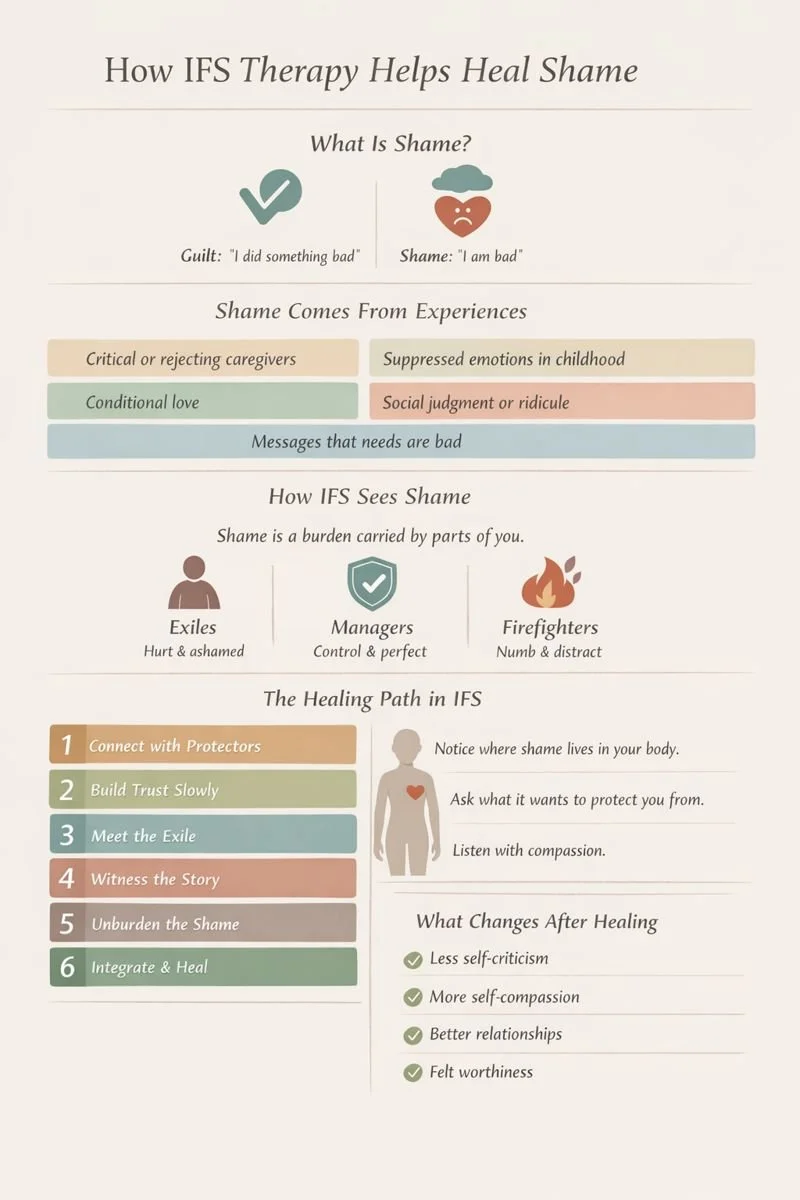
How IFS Helps to Unburden Parts Holding Shame
Internal Family Systems approaches shame by changing the order of care.
Instead of challenging shame directly, the work begins with the parts that guard against it.
The first stage is learning to relate to the protectors in your system with curiosity rather than resistance. As they are acknowledged for their protective role, something important happens: the internal battle softens.
Trust with protectors develops slowly. Protectors need evidence that the core Self can tolerate what they have been managing for years, and that the parts they protect will not be overwhelmed again.
Only when that trust is in place does the work move toward the shame itself. Beneath the protectors is often a very young part, frozen around an early experience of ridicule, rejection, or misunderstanding. This part does not need to be corrected or reassured away. It needs presence. Shame loosens through being seen with compassion.
From compassionately witnessing, what is known as “unburdening” becomes possible. This means that when the part is ready, it releases beliefs and sensations that created shame - in its own way and timing.
As shame lifts, the internal system of parts reorganises. Protectors no longer have to work as hard. Internal attacks quiet down. There is more access to calm, clarity, and connection. Changes in behaviour and relationships follow naturally, without being pushed.
This process unfolds gradually during therapy as there are often multiple layers of shame to tend to. Each one that heals shifts the system toward a lived sense of worth that no longer needs to be proven or defended.
A Small IFS Practice to Work with Shame
The next time you feel shame stirring, try this:
Pause and notice where it lives in your body.
Instead of asking, “How do I stop feeling this?” ask, “What are you afraid would happen if you didn’t make me feel ashamed?”
Listen gently. You may be surprised by how protective its answers sound.
When shame feels understood, it loses its sting. It can step back, and something quieter and kinder inside you (what IFS calls Self) can take the lead.
When to Seek IFS Therapy for Shame
You should work with a trained IFS therapist if:
Shame significantly impacts your life (relationships, work, health)
You have trauma history, especially childhood trauma
Shame connects to suicidal thoughts or self-harm
You feel overwhelmed when shame surfaces
You've tried self-work and feel stuck
You want deep, lasting transformation
Conclusion: You Are Not Your Shame
If you've lived with shame for so long that it feels like "just who you are," I want you to know:
Shame is not your identity. It's a burden that young parts of you are carrying.
You're not fundamentally flawed. You're not unworthy of love.
You're a person who experienced painful things, and parts of you internalised messages about your worthiness that were never true.
Those burdens can be released.
Through IFS therapy, you can:
Meet the parts carrying shame with compassion
Witness their stories without being consumed
Help them release what was never truly theirs
Experience yourself as whole, worthy, and enough
You don't have to spend the rest of your life hiding, performing, or criticising yourself.
That young part carrying shame has been waiting to be seen, heard, and released from the burden.
Take the Next Step
I'm Corene Crossin, a licensed psychotherapist who helps people with shame, complex trauma, and self-worth with IFS therapy offered online. My approach to IFS is deeply compassionate and collaborative. Learn more about me here or if you’d like support with parts that hold shame, book a free 20 minute connection call with me to explore if I am the right IFS therapist for you.
Check out other articles:
How Do I Explain IFS Therapy to My Partner?
