Why you feel torn between two choices and how IFS therapy helps
Feeling torn between two choices is one of the most common experiences that brings people to therapy. Perhaps you know that persistent inner conflict, the endless mental replay of pros and cons, the physical tension that builds as you try to force yourself toward a decision. These are signals that different parts of you are working hard to protect you, each in their own way.
If you've found yourself searching for answers about feeling torn between two choices, stuck in indecision, or caught in internal conflict, you're not alone. This experience touches something deeply human: the reality that we contain multitudes, and sometimes those different aspects of ourselves have competing needs, values, and fears.
Internal Family Systems (IFS) therapy, sometimes also called “parts work”, offers a compassionate and effective framework for understanding why decision making can feel so overwhelming. More importantly, IFS provides a path to move through it with clarity and self-trust.

Understanding Why Decision Making Feels So Hard: An IFS (Parts Work) Perspective
When you're faced with a significant choice your mind might feel like a committee room where everyone is talking at once. One voice urges you forward with excitement and hope. Another cautions you to wait, highlighting every possible risk. A third might criticise you for not having figured this out already.
This isn't just overthinking. It's not a character flaw or a sign that you lack willpower. What you're experiencing is internal conflict between different parts of your psyche, each holding important information and trying to guide you based on what they've learned throughout your life.
Internal Family Systems therapy recognises that our psyche is naturally multiple: we all have different parts that emerge in different contexts. When you're with your parents, certain parts of you show up. At work, you might present differently. With close friends, you access other aspects of yourself. This multiplicity is normal and healthy.
Problems arise when these parts get into conflict with each other, especially during times when important decisions need to be made. The feeling of being torn between two choices is actually the experience of having two or more protective parts in active disagreement about what's best for you.
The Inner Landscape of Indecision
Let's look more closely at what happens inside when you feel torn. You might notice your mind jumping between options, sometimes multiple times in a single hour. You imagine yourself choosing one path and immediately your thoughts pivot to why that might be wrong. You consider the alternative and a wave of anxiety or doubt appears.
Your body often reflects this internal tug-of-war. You might experience tightness in your chest or shoulders, shallow breathing, difficulty sleeping, or a persistent sense of pressure. Some people describe it as feeling paralysed, while others feel agitated and restless. These physical sensations are signals from your nervous system that parts of you are activated and trying to get your attention.
Many people who struggle with decision making also notice patterns of self-criticism emerging. There might be a harsh inner voice that says you should know what to do by now, that you're weak for struggling with this, or that either choice you make will be wrong. This critical voice is also a part that learned to motivate through judgment, usually because it believes this will keep you safe from making mistakes.
The experience of feeling torn can also trigger shame. You might compare yourself to others who seem to make decisions easily. You might worry that your indecision is burdening the people around you. You might feel embarrassed that something that seems straightforward to others feels so complex to you.
All of these experiences (the mental loops, the physical tension, the self-criticism, the shame) are actually parts of you working very hard. They're evidence that your internal system is highly activated and that different parts are trying to protect you in the ways they learned.
When Decision Making Anxiety Becomes a Pattern
For some people, feeling torn between choices isn't a one-time experience but a recurring pattern. If you find yourself regularly stuck in indecision, unable to commit to a direction, or constantly second-guessing yourself after you do make choices, this pattern itself is worth exploring.
Chronic indecision often points to a part (or multiple parts) that learned that making choices is dangerous. Perhaps in your family of origin, choosing wrongly led to criticism or withdrawal of love. Perhaps you learned that your desires didn't matter, so parts of you stopped even trying to know what you want. Perhaps unpredictable consequences made your system conclude that any choice could lead to disaster.
Whatever the origin, when indecision becomes a pattern, it's usually a sign that your system needs more than just help with the current decision. It needs healing around the deeper fears that keep your protective parts locked in this pattern.
IFS therapy is particularly effective for this kind of systemic work. By addressing not just the immediate decision but the underlying dynamics that create chronic indecision, you can develop greater confidence in your ability to choose and commit to a direction.
How Protector Parts Shape Your Decisions
In IFS therapy, we understand that certain parts organise themselves around one core purpose: to protect you. Some parts do this by pushing you forward, encouraging action, risk-taking, and change. Others protect you by pulling you back, urging caution, highlighting dangers, and maintaining the familiar.
These protective strategies usually formed earlier in your life, often in response to experiences where you needed to adapt in order to stay safe, belong, or get your needs met. Protector parts aren't trying to make your life difficult. They're doing exactly what they were designed to do; using strategies that worked at some point in your life to keep you from pain, rejection, failure, or other forms of suffering.
During decision making, these protectors can take very strong positions. One protective part might insist that you must take action now. This part might carry feelings of excitement, hope, restlessness, or even desperation for things to be different.
Another protective part might be equally insistent that you need to slow down and consider every possible consequence. This part might generate anxiety about the unknown, worry about what others will think, or remind you of past times when change led to difficulty.
When these parts get polarised (when they take up opposing positions and dig in their heels) you end up feeling torn. Each side makes compelling arguments. Each side genuinely believes it knows what's best for you. And you're caught in the middle, trying to adjudicate between them while feeling increasingly stressed and overwhelmed.
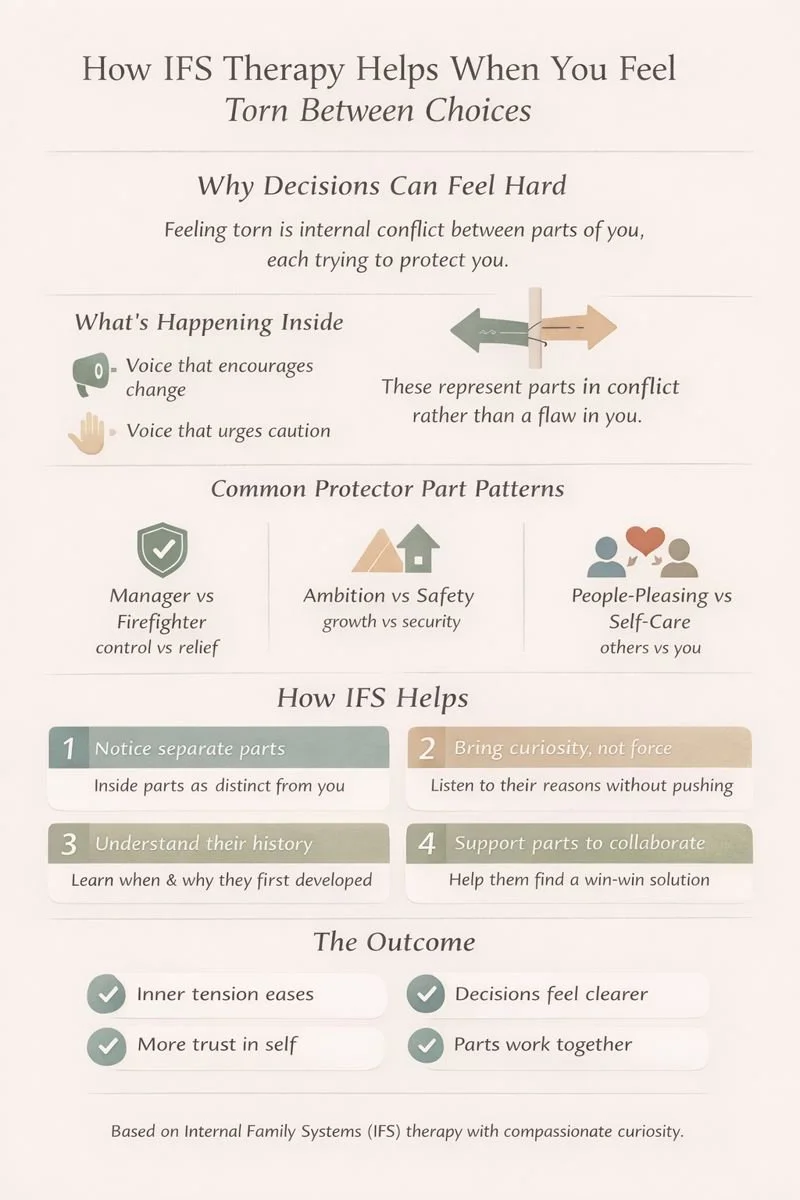
Common Protector Part Patterns in Decision Making
While every person's internal system is unique, certain patterns appear frequently when people feel torn between two choices:
The Manager and the Firefighter: One part tries to maintain control, plan carefully, and prevent problems (the Manager), while another part wants immediate relief from the discomfort of the decision itself (the Firefighter). The Manager says "We need to think this through completely," while the Firefighter says "I can't stand this anymore, just pick something."
The Ambitious Part and the Safety Part: One part is excited about growth, new possibilities, and stepping into something bigger. Another part prioritizes security, predictability, and protecting you from potential failure or loss. Both are valuable, but when polarized, they create intense internal conflict.
The People-Pleasing Part and the Self-Care Part: One part focuses on what others need, want, or expect from you. It considers how your decision will affect everyone else and tries to minimize disappointment or conflict. Another part advocates for your own needs, desires, and wellbeing. The tension between these parts can feel particularly difficult when the choice involves disappointing someone important to you.
The Optimist and the Pessimist: One part sees the best possible outcome and all the reasons why things will work out well. Another part focuses on everything that could go wrong and why you should expect difficulty or failure. When these parts are in conflict, you might feel pulled between hope and dread.
How IFS Therapy Helps To Transform Indecision
Internal Family Systems therapy doesn't try to eliminate parts or force them to agree. Instead, it offers a fundamentally different approach: helping you develop a relationship with your parts from a place called Self.
Self, in IFS language, is the core of who you are and is the aspect of you that can observe your parts with curiosity, compassion, and clarity. When you're in Self, you're not identified with any single part. You're not caught in the conflict. You have space to listen to each part, understand what it's trying to do, and help them work together rather than against each other.
In IFS therapy, when you're struggling with a decision, the process typically involves these steps:
Noticing the parts: First, you learn to identify the different parts that are active around this decision. Instead of experiencing them as a chaotic blend of feelings and thoughts, you begin to see them as distinct—each with its own perspective, feelings, and concerns. You might notice the part that's excited about change lives in your chest with a feeling of expansion. The worried part might show up as tension in your shoulders with thoughts about everything that could go wrong.
Getting curious: Rather than trying to quiet the parts or push through the conflict, you bring curiosity to each one. What is this part concerned about? What is it hoping for? What does it need you to understand? This curiosity—which comes from Self—is fundamentally different from the judgment or frustration you might usually feel toward your indecision.
Understanding their history: As you get to know your parts, you often discover that they're not really responding to the current situation. They're reacting based on past experiences where they had to protect you. The part that fears change might still be trying to protect you from an unpredictable childhood environment. The part that pushes for independence might be guarding against the vulnerability you felt when you depended on unreliable caregivers. When you understand why parts do what they do, they begin to soften.
Addressing underlying fears: Beneath the conflict between protective parts, there are often younger parts (what IFS calls exiles) that carry difficult emotions from the past. These might be parts that feel abandoned, rejected, inadequate, or unsafe. The protectors fight with each other because they're each trying, in different ways, to make sure these vulnerable parts don't get hurt again. When you can offer care and healing to these younger parts, the protectors don't need to fight so hard.
Supporting parts to collaborate: As parts feel heard and understood, something shifts. They begin to trust that you (your Self) can lead the decision making process. They don't need to be in such extreme positions anymore. The part that wants change can acknowledge the wisdom in being thoughtful. The part that wants safety can relax enough to consider new possibilities. From this place of collaboration, decisions become clearer.
How IFS helps resolve inner conflict
One of the most profound and healing experiences in IFS therapy is what happens when parts genuinely feel listened to. People often describe a physical sensation of release (shoulders dropping, breath deepening, a kind of inner spaciousness opening up). The mental loop stops. The tension eases.
This doesn't necessarily mean the decision suddenly becomes obvious. Sometimes it does and the path forward becomes clear once the noise settles. Other times, the complexity remains, but your relationship to it changes. You can hold the difficulty without being overwhelmed by it. You can acknowledge that both choices have merit without feeling torn apart by them.
Clients frequently report that after IFS work around a difficult decision, they feel more present, more like themselves. Even if they're still weighing options, they're no longer caught in the anxious loop. They can think clearly. They can feel what they actually want, beneath the layers of protection and fear.
This shift happens because when parts feel heard, they can step back from their extreme roles. They don't need to shout to get your attention. They can share their concerns without taking over your whole experience. And from that calmer inner place, your Self can guide you forward.
IFS Therapy at A New Chapter: A Different Approach to Feeling Torn
If you're reading this because you've been caught in indecision, replaying the same internal arguments, and searching for a way through, IFS therapy offers something different from traditional approaches to decision making.
Instead of pro-and-con lists (which often just fuel the debate between parts), instead of trying to think your way to certainty, instead of pushing yourself to "just decide already," IFS invites you to slow down and listen inward with curiosity and compassion.
At A New Chapter, I provide online IFS therapy that creates a safe, calm space for this inner work. In our sessions together, you'll learn to:
Identify the different parts of you that are active around difficult decisions
Understand what each part is trying to protect you from
Unblend from parts so you can access your Self
Build a compassionate relationship with all aspects of yourself, including the parts you've been frustrated with
Address the underlying vulnerabilities that keep protective parts polarised
Make decisions from a grounded, clear place that honours all of who you are
This work is gentle and goes at your pace. You don't need to have everything figured out before we start. In fact, the confusion, the feeling of being torn, or the sense that you "should" know what to do are exactly what we'll explore together.
You're welcome to book a free 20-minute connection call with me to explore how IFS therapy at A New Chapter can support you. In this call, we can discuss what you're experiencing, answer your questions about IFS, and see if this approach feels right for you. You can schedule your call here.
Feeling torn isn't a flaw in who you are. It's a sign that different parts of you care deeply about getting this right. When you slow down and meet them with curiosity and compassion, clarity naturally emerges. And that's exactly what IFS therapy is designed to help you do.
Explore other articles:
Mapping Your Parts in IFS: How to Get Started
About Internal Family Systems Therapy
How IFS Therapy Can Help You Stop Self-Sabotaging
About A New Chapter: A New Chapter offers compassionate online Internal Family Systems (IFS) therapy for individuals throughout Australia. Based in Brisbane, Queensland, sessions are available Monday-Friday 8am-7pm and Saturday 8am-1pm AEST, with out-of-hours appointments available upon request. To learn more or schedule a free 20-minute connection call here.
